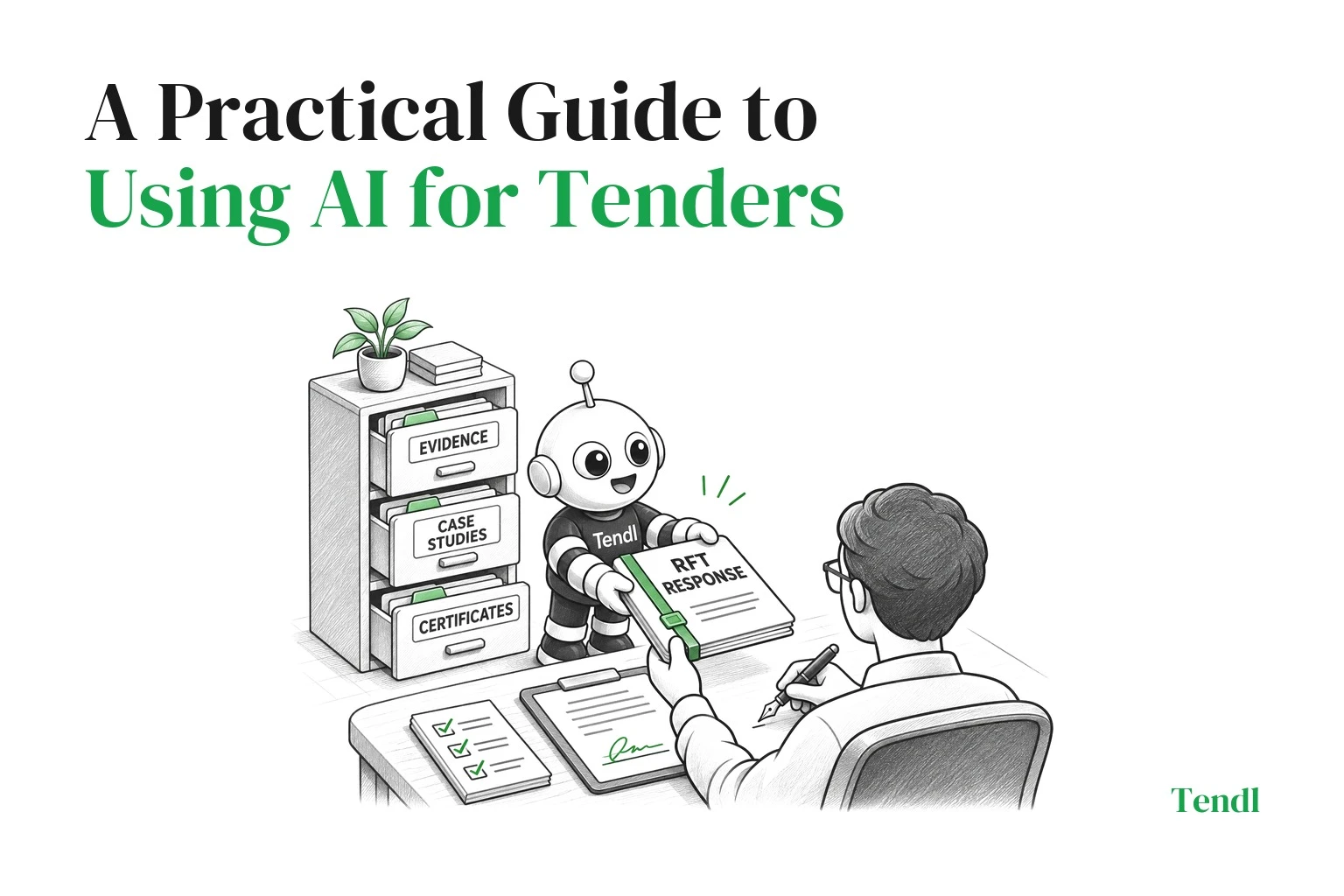
A Practical Guide to Using AI for Tenders
AI for tenders means using AI to read, sort, score and draft across the tender lifecycle, from finding opportunities to managing the pipeline, while your team keeps the decisions on what to bid, what to commit to and what to sign.
Most conversations about AI in tendering start and finish with writing. Writing is the most visible part of a tender, so that makes sense. The response is only one stage, though. Before it, someone has to find the opportunity and decide whether it is worth pursuing. During it, a group of people has to contribute, review and approve. After it, someone has to manage the bid as part of a pipeline the business relies on.
AI can help at every one of those stages. It can also do damage at every one of them if it is used without structure. This guide works through the whole tender lifecycle, stage by stage. For each stage it covers what AI does well, what it needs from you, and where your team still makes the call.
What we mean by AI for tenders
In this guide, AI means large language models working on your tender documents and your own content. They can read, summarise, compare and draft. They cannot know your pricing strategy, your relationship with the buyer or your appetite for risk unless you give them that context, and even then the judgement belongs to your team.
That distinction matters because buyers evaluate tenders on risk. An evaluator is looking for the supplier they can defend choosing. A response that reads well but promises things your team cannot deliver is a liability, however quickly it was produced. We explore this further in Evaluators Are Not Looking for the Best Bid.
Stage one: finding the right opportunities
Discovery is where most teams lose time without noticing. In Australia, opportunities sit across AusTender, VendorPanel, state portals such as NSW eTendering, QTenders and Buying for Victoria, council sites, panels and email alerts. Someone has to read each notice to work out whether it is relevant.
Where AI helps
- Reading every notice across your sources and flagging the ones that match your services, regions and contract sizes.
- Summarising a long tender pack into the scope, key dates, mandatory requirements and evaluation criteria, so a manager can review it in minutes.
- Spotting opportunities that use different language from your own, such as a “facilities maintenance panel” for a team that describes itself as building services.
What it needs from you
A clear description of the work you want and the work you do not. The better you define your target market, the less noise the AI passes on.
Where your team decides
Which opportunities are worth a closer look. AI can sort a long list into a short one. Choosing from the short list depends on what you know about the buyer and your current capacity.
Stage two: deciding whether to bid
Qualification is the highest-value decision in tendering. Every bid costs time and money, and a weak bid also costs your best people evenings they could have spent on the work you are good at. We cover the economics in What Does It Actually Cost You to Produce a Bid?
Where AI helps
- Checking the requirements against your capability, certifications and past projects, and listing the gaps.
- Scoring an opportunity against your go/no-go criteria so every bid is assessed the same way.
- Pulling out the details that change the decision, such as insurance levels, local content rules or a short response window.
What it needs from you
A written set of criteria. If your team decides on instinct, AI has nothing consistent to score against. Our bid/no-bid framework is a good starting point.
Where your team decides
The go or no-go call itself. AI can show you that a tender scores poorly. Only your team knows whether this buyer is strategic enough to bid anyway, or whether the timing makes it impossible.
Stage three: drafting the answers
This is where AI saves the most visible time, and where the risks are best understood. A first draft that took a day can be produced in minutes. That draft is only as good as the material behind it.
Where AI helps
- Breaking the tender into individual requirements and building a compliance matrix, so nothing is missed.
- Drafting answers from your approved content: past responses that won, case studies, CVs, policies and certificates.
- Keeping answers inside word and character limits, and in the buyer’s template.
- Reviewing a draft against the evaluation criteria and pointing out where the evidence is thin.
What it needs from you
A response library and supporting evidence that are current, approved and easy to find. AI drafting from an outdated policy or an unverified claim produces confident text that is wrong. We go into this in How to Use Your Response Library to Tender With AI and Store Your Supporting Evidence Properly.
Where your team decides
The win themes, the pricing and the commitments you are prepared to make. For the practical limits of AI drafting, see What AI Can and Can’t Do for Tender Writing and AI for Tender Writing: Limitations, Workarounds, and Best Practices.
Stage four: building the response as a team
A first draft is the easy part. Most bids are put together by several people: a bid manager, subject-matter experts in delivery, safety, finance and quality, and a senior reviewer who signs off. This is where bids usually come under pressure. Questions go out by email, answers come back in different versions, and near the deadline nobody is sure which answer is current or who approved it.
Where AI helps
- Sending each question to the right expert with the draft already written, so they review and correct it rather than starting from a blank page.
- Comparing versions and showing what changed between drafts.
- Flagging answers that are still unassigned, unreviewed or over the word limit as the deadline approaches.
What it needs from you
Everyone working in one place. AI cannot track an answer that lives in someone’s inbox. Every expert and reviewer needs to work in the same response, with a named owner for each answer.
Where your team decides
What the response says. Experts confirm the facts, the bid manager shapes the story, and a named person approves each answer before it goes out. That record of who wrote, reviewed and approved each answer is also what a buyer will ask for if they query how the response was produced.
Stage five: managing the pipeline
Once tenders are submitted, most teams lose sight of them as a group. Each bid is tracked in its own folder, and nobody can say with confidence how much revenue is in play or what the team has capacity for next quarter.
Where AI helps
- Keeping a live view of every bid, its value, its stage and its likely decision date.
- Weighting the pipeline by your actual win rates, so the forecast reflects reality.
- Capturing what happened on each bid, including debrief notes, so the next response starts from what you learnt.
What it needs from you
Honest data. Win and loss outcomes, debriefs and bid costs all need to be recorded, including the losses.
Where your team decides
Where to focus. A pipeline view shows you which sectors and buyers you win in. Deciding to pursue more of that work, or to fix why you lose elsewhere, is a commercial decision.
What buyers expect when you use AI
Buyers are starting to ask suppliers how AI was used in a response, and some now include disclosure questions in their tender documents. Their main concern is accountability. A buyer wants to know that a named person stands behind every claim in the response. We cover what buyers are asking in AI Disclosure in Public Procurement.
The safest position is a simple one. Use AI to work faster on approved material, keep a record of who wrote, reviewed and approved each answer, and be ready to explain that process if asked. In Tendl that record is kept automatically for every answer, so the evidence exists when a buyer asks for it.
Where your content goes
The question bid teams ask most about AI is what happens to their content. Tender responses hold pricing, client names, methodologies and staff details, and a lot of it is commercially sensitive. Before you put that into any AI tool, it is worth asking three things:
- Where is the content stored, and in which country?
- Who can access it, inside the vendor and inside your own team?
- Is it used to train models that other customers use?
Tendl is hosted on IRAP-assessed AWS infrastructure in Australia, and your data stays onshore. Tendl also holds ISO 27001 certification for information security.
How to start
You do not need an AI strategy to get value from AI in tendering. A few habits do most of the work.
- Start with your content. Gather your best past responses, case studies and certificates into one place and remove anything out of date.
- Write down your bid criteria. Agree what a good opportunity looks like before you ask AI to score one.
- Use AI on one stage first. Requirement extraction and compliance matrices are low-risk and save time immediately.
- Bring the team into one place. Give every expert and reviewer access to the same response, with a named owner for each answer.
- Keep a person on every decision. Qualification, pricing, commitments and sign-off stay with your team.
- Record what happens. Outcomes and debriefs are what make the next bid better.
For a lighter take on the same idea, see You Don’t Need an AI Strategy.
Where Tendl fits
Tendl is a system of record for tendering. It keeps your approved content, evidence, decisions and bid history in one place, and gives every bid the same structure from first notice to final outcome.
Every subject-matter expert and reviewer works in the same response, with no per-seat limits, and every answer carries a record of who wrote, reviewed and approved it. AI does the reading and the first drafts, and your team makes every decision. Your data is hosted in Australia.
If your team does not have the capacity to bid, Run For You puts experienced tender managers on the Tendl platform to run the response for you. You keep the go/no-go call, the pricing and the sign-off, and your people stay focused on running the business.
Frequently asked questions
Can AI write a whole tender response? It can draft most of one. A draft is only as reliable as the approved content behind it, and every answer still needs review by someone who knows the work and can stand behind the claims.
Is it acceptable to use AI in a government tender? In most cases, yes. Some buyers now ask suppliers to disclose how AI was used. Check the tender documents for any disclosure requirements and keep a record of who wrote, reviewed and approved each answer.
What is the best AI tool for tenders? Most teams already have a tool that can write. What they usually lack is everything around the writing: a way to bring subject-matter experts into the response, a clear review and approval process, and one source of truth for content and evidence across every bid. Look for a tool that covers those, because that is where most bids lose time and quality.
Will AI replace bid writers? AI changes what bid writers spend their time on. Less time goes on reformatting and first drafts, and more on strategy, evidence and review. The judgement that wins tenders still comes from people.
How do I stop AI making things up in a tender? Give it only approved, current content to draft from, and review every answer against the evidence before submission. Never let it fill a gap with a claim your team has not verified.
Where does my content go when I use AI for tenders? That depends on the tool. Ask where it is stored, who can access it and whether it is used to train models. Tendl is hosted on IRAP-assessed AWS infrastructure in Australia, and your data stays onshore.