Why do capable firms lose tenders to weaker competitors?
The firm winning the work you wanted is rarely the better operator. In technical contracting the team that wins is frequently not the strongest engineer or the safer pair of hands. It is the team whose bidding carries less friction, reuses a proven position instead of rebuilding it, and gets a credible submission in while the stronger firm is still pulling answers out of three people’s heads.
That is an uncomfortable thing to accept, because it means the loss was not really about the work. It was about everything around the work.
Capable firms lose to weaker competitors because the evaluation rewards the response, not the underlying capability, and the response is where the disorganised firm gives ground. A buyer cannot see how good your engineering is. It can only see what you submitted, how clearly it answered the criteria, and how convincingly you evidenced it. A strong firm with a rushed, half-remembered response presents as a weaker bid than an average firm with a complete and well-evidenced one.
The data supports how rarely quality is the deciding factor. Loopio’s 2026 benchmark, drawn from more than 1,500 response teams, found that only 13 percent of teams attribute their losses to proposal quality. Price and competition remain the dominant reasons, cited at 55 percent each. Teams are confident their work is good. They are losing on other ground.
For a technical firm that prides itself on delivery, this is the part worth sitting with. The market is not telling you the work is weak. It is telling you the work alone is not what gets scored.
What does the winning firm actually do differently
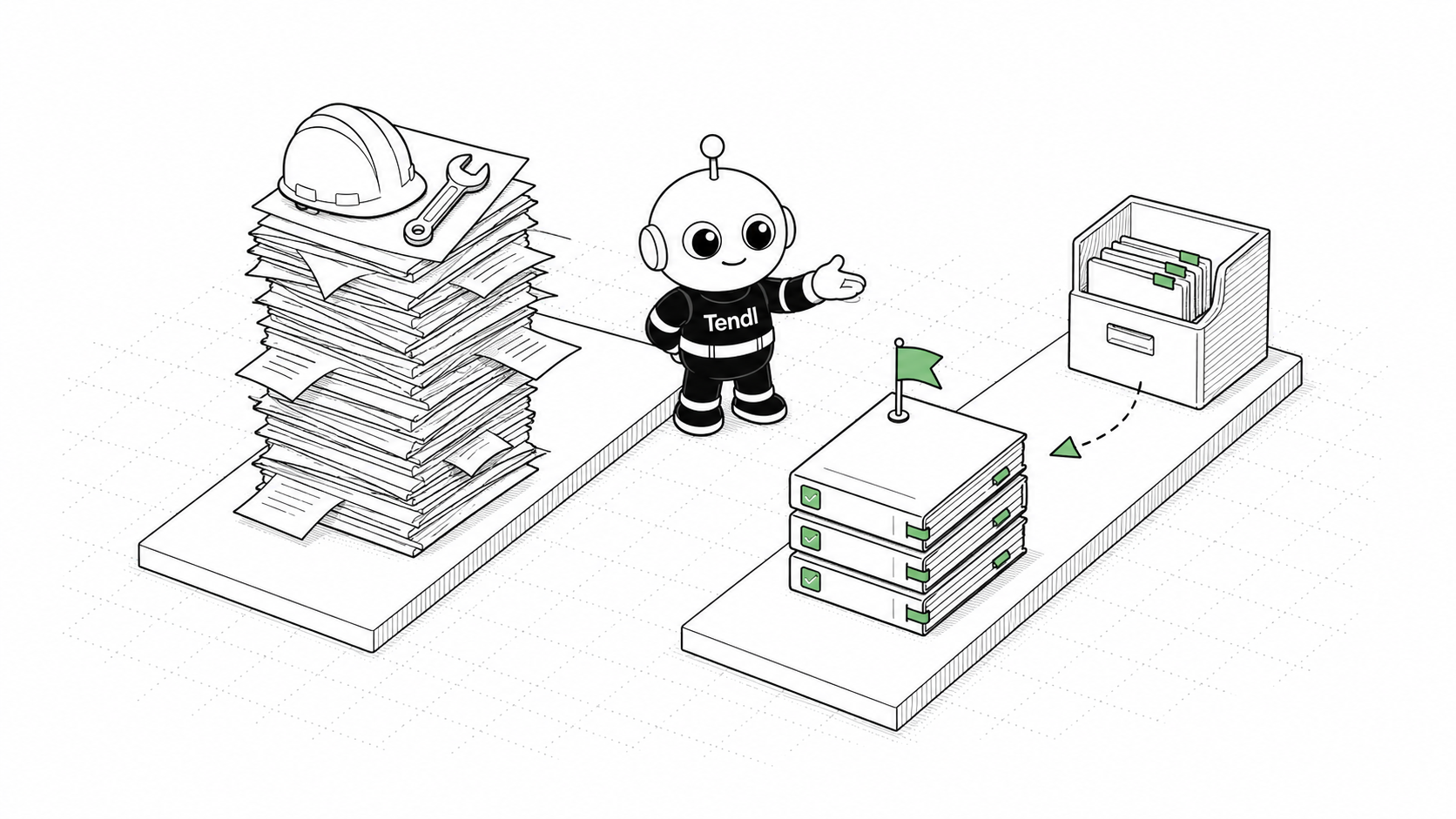
The winning firm treats each tender as a known problem rather than a fresh one. Its strongest answers, its qualified positions, and its evidence of delivery already sit somewhere it can reach, so a new response assembles from proven material rather than starting from a blank page. The competitor is not writing a better bid from scratch each time. It is no longer writing from scratch at all.
This is the difference between effort and a system. Effort does not accumulate. The senior engineer who wrote a brilliant answer last quarter carries that answer in their head, and when they are busy, or away, or on the live job that actually pays, the answer is gone and the next bid rebuilds it. A system holds the answer, so the next bid improves on it.
Over a year of tenders, that gap compounds quietly. Two firms of equal capability diverge, not because one got better at the work, but because one got better at holding on to what it already knew.
Is the problem the writing or the system behind it?
The problem is almost never the writing, and treating it as a writing problem is what keeps capable firms stuck. Faster drafting has been available to everyone for some time now, so the firm that buys speed alone buys the one advantage every competitor already has. Output goes up. Win rate does not move, because the thing that was missing was never the words.
What was missing is the system underneath the words. The qualified position that says this is the work we should chase and this is the work we should decline. The governed evidence that proves the claim rather than asserting it. The institutional memory that means the firm’s best thinking survives the person who happened to produce it. None of that is a drafting feature. It is infrastructure, and it is what the consistent winner has and the occasional winner does not.
How a technical firm closes the gap
A technical firm closes the gap by giving its bidding the same system its delivery already has. The engineering side of these businesses runs on standards, version control, and documented method. The bidding side, in firms without a dedicated bid team, usually runs on memory and whoever has a free evening. The capability to win is already there. The system to make winning repeatable is what is absent.
This is the work a Response Management System does. Tendl holds the firm’s qualified positions, its evidence, and its strongest answers in one governed place, so each response is assembled from proven material rather than rebuilt under pressure. The senior people stay where they are most valuable, on judgement and on delivery, while the response itself stops costing the firm its scarcest hours. AI carries the assembly. People own the decisions. The work that was always good enough starts winning at the rate it should.
The competitor beating you is not a better operator. It has a better system around the same standard of work. That is a gap you can close, and closing it is how you win the work you should be winning.