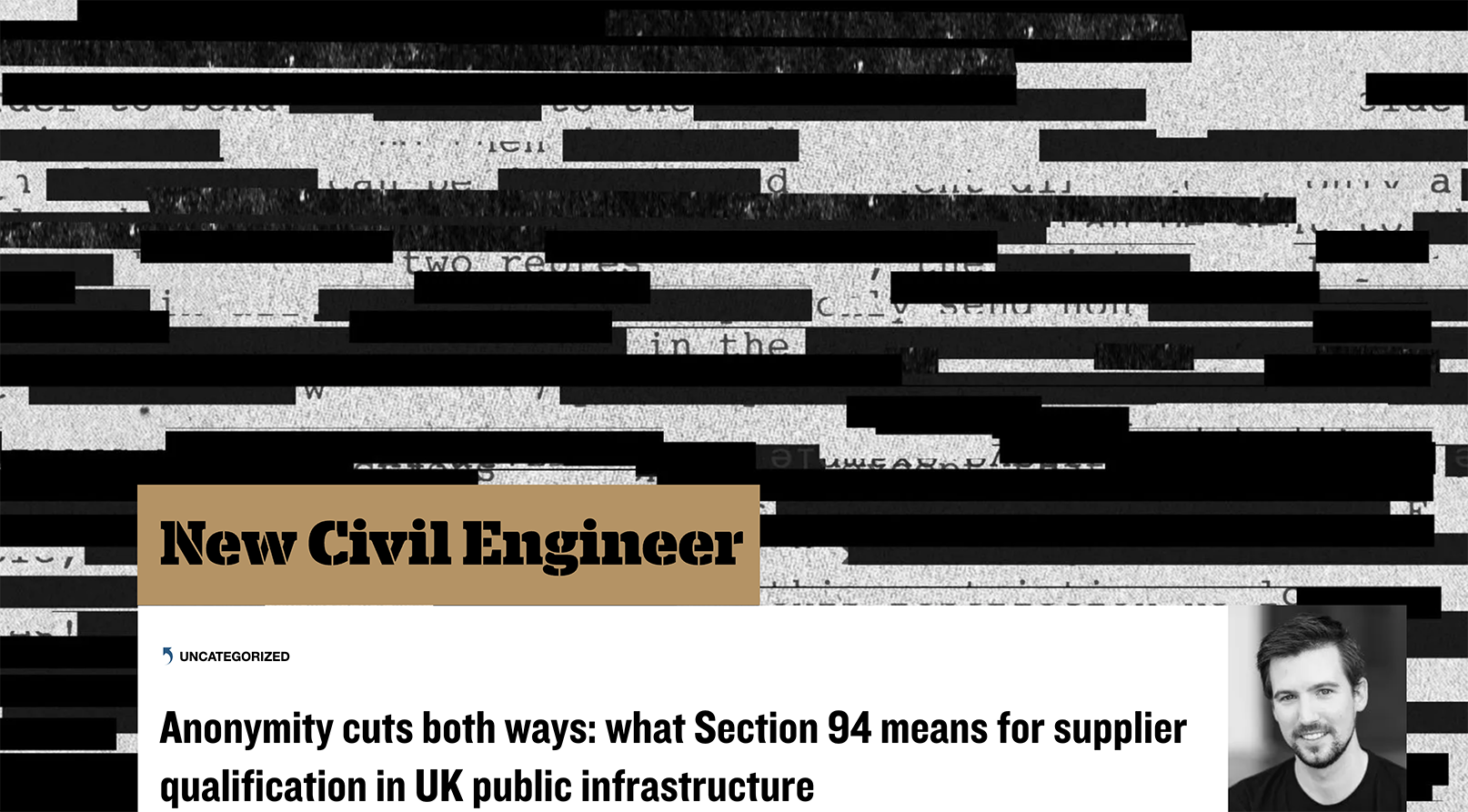
Published in New Civil Engineer, 8 June 2026. By Tendl founder and CEO Laurie Nicol.
Section 94 of the Procurement Act 2023 lets contracting authorities withhold supplier identity on grounds of national security or commercial sensitivity. The Pan Government Collaborative Agreement put that power to work at scale, awarding £3.5bn in contracts on 8 April 2026 without naming a single supplier. Most coverage treated this as a transparency story. Nicol shows it is also a market-structure story, with direct commercial consequences for anyone who wins work in defence, nuclear, and critical infrastructure.
For decades the public record was the spine of supplier qualification, the audit trail buyers used to test capability claims and competitors used to benchmark each other. Section 94 removes that spine wherever national security applies. The delivery still happened, but it can no longer be referenced, which leaves the evidence a supplier governs internally as its only credible qualification asset. Nicol argues the contest now favours the organisation with the cleanest internal evidence base, captured at project closeout with the right attribution, metrics, and classification rules applied at the point of capture. Institutional memory becomes the moat, and anonymity, as the title has it, cuts both ways.