Four research bodies. One finding. The 2026 AI consensus has formed around governance.
Over recent months, four independent research bodies have published findings on the conditions under which generative AI generates enterprise value. The publications were prepared separately, examined different functions across different sectors, and applied distinct methodologies. The conclusions they reach are substantively the same.
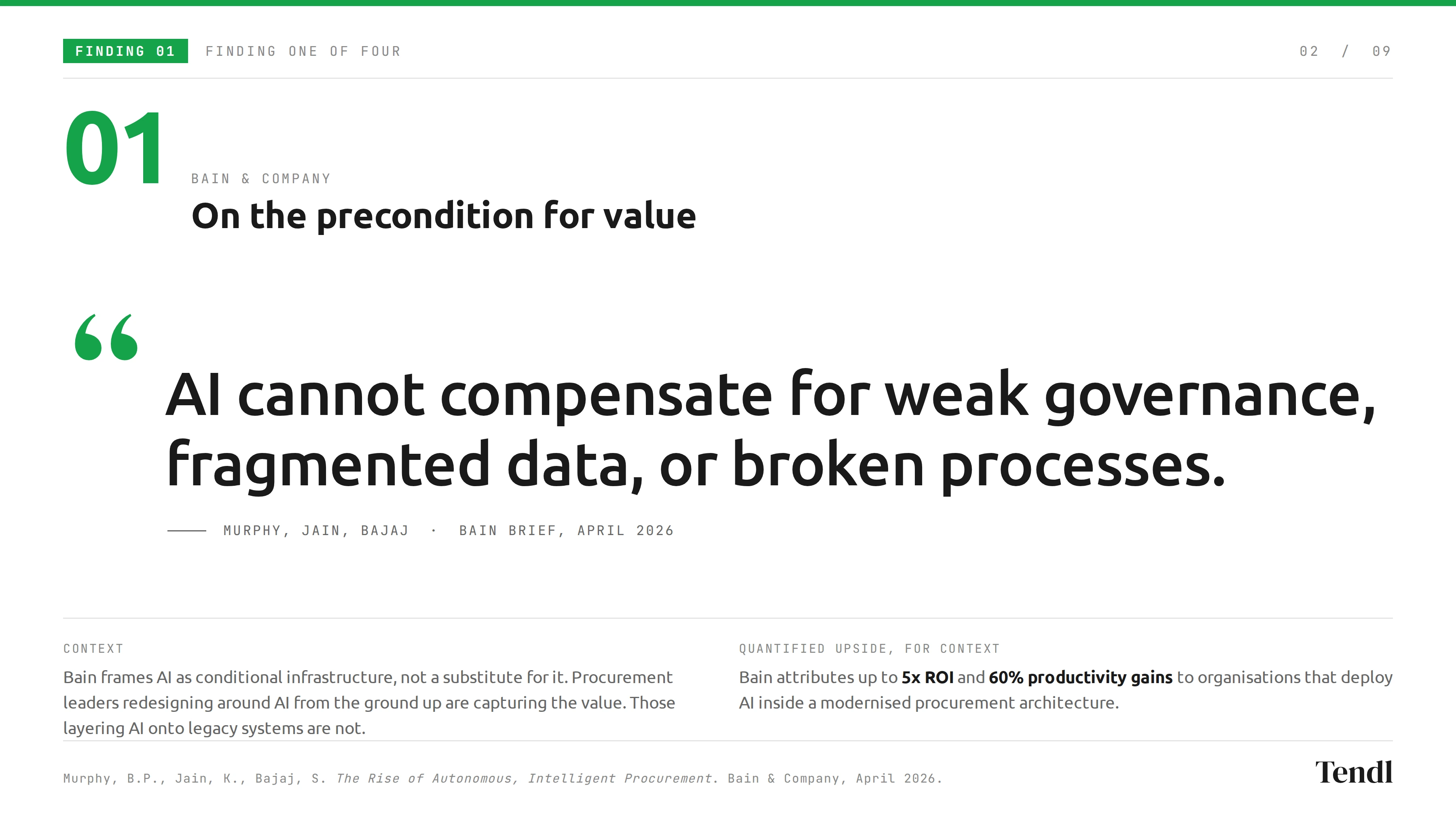
Bain & Company, in its April 2026 brief The Rise of Autonomous, Intelligent Procurement, concludes that “AI cannot compensate for weak governance, fragmented data, or broken processes.” The observation appears in the context of an analysis of procurement transformation, but the principle is generalised. AI deployed onto unstable foundations exposes the data, process and governance weaknesses already present in the system.
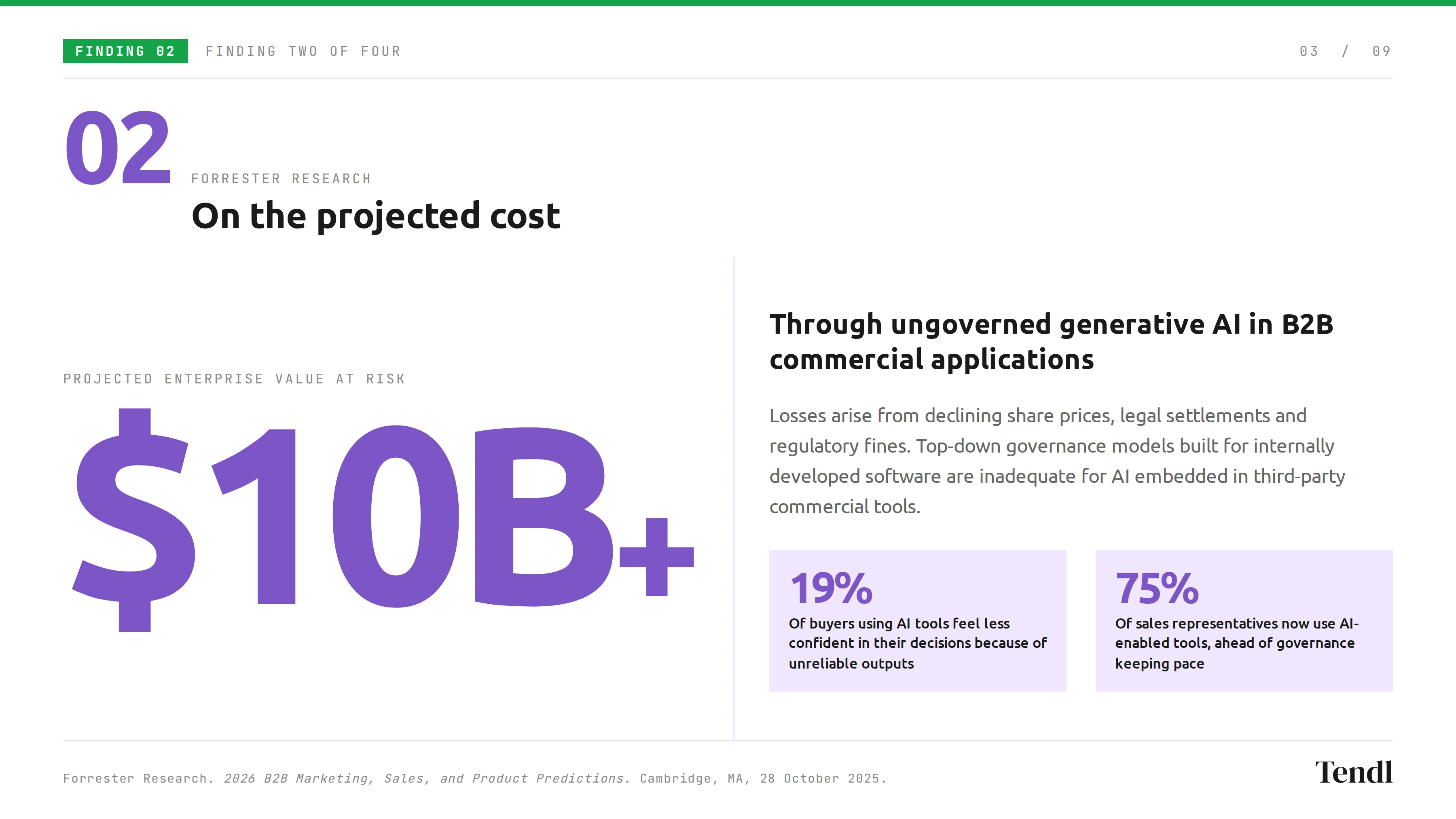
Forrester, in its 2026 B2B Marketing, Sales, and Product Predictions published in late October 2025, projects that B2B companies will lose more than ten billion US dollars in enterprise value through ungoverned use of generative AI, with losses arising from declining share prices, legal settlements and regulatory fines. The mechanism cited is the inadequacy of top-down governance models when AI is embedded in third-party commercial applications.
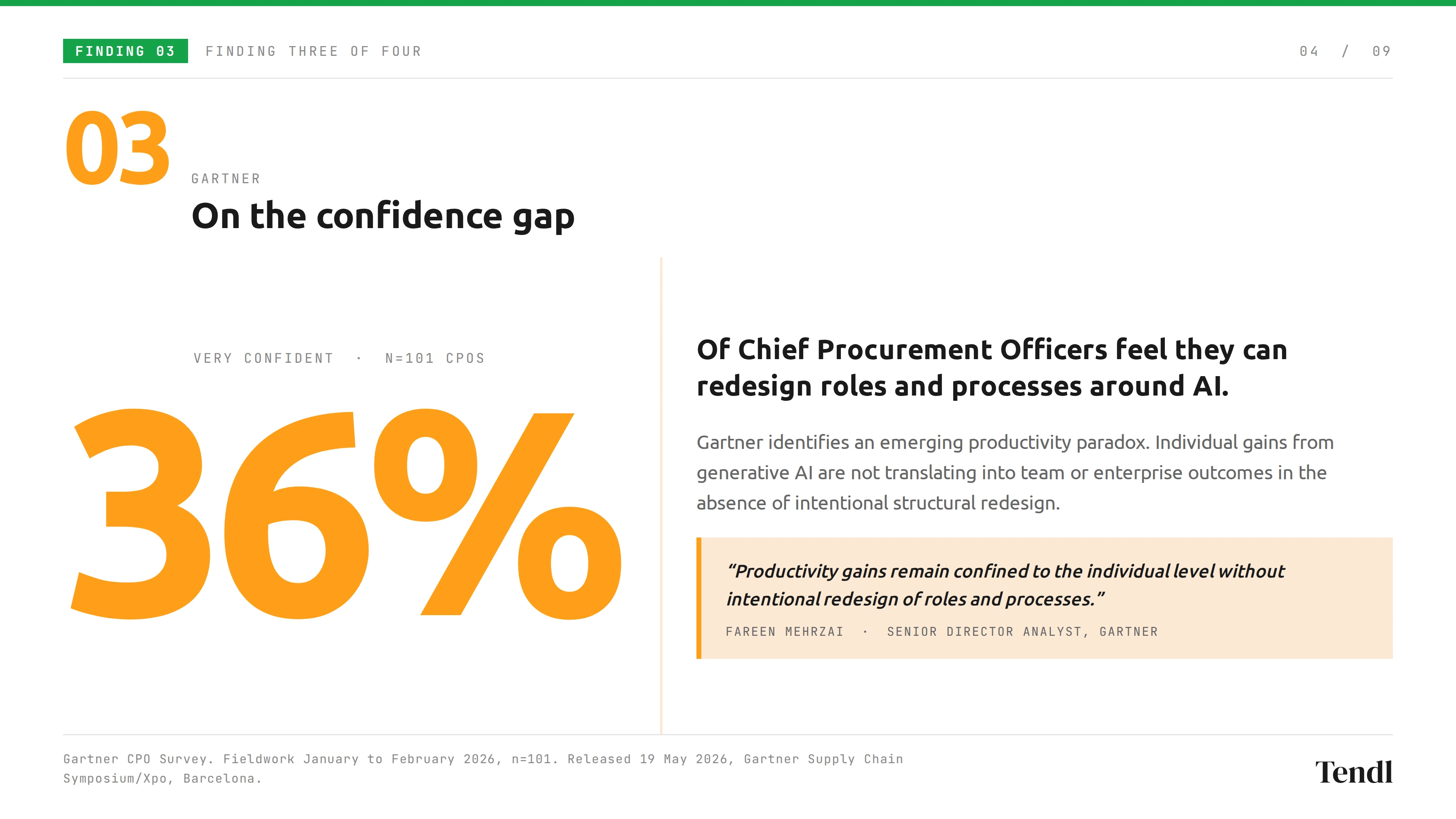
Gartner, in its May 2026 CPO Survey of 101 Chief Procurement Officers, reports that only 36 percent of respondents are very confident in their ability to redesign roles and processes around AI. The survey identifies an emerging productivity paradox: individual AI productivity gains are not translating into broader team or enterprise outcomes in the absence of intentional structural redesign.
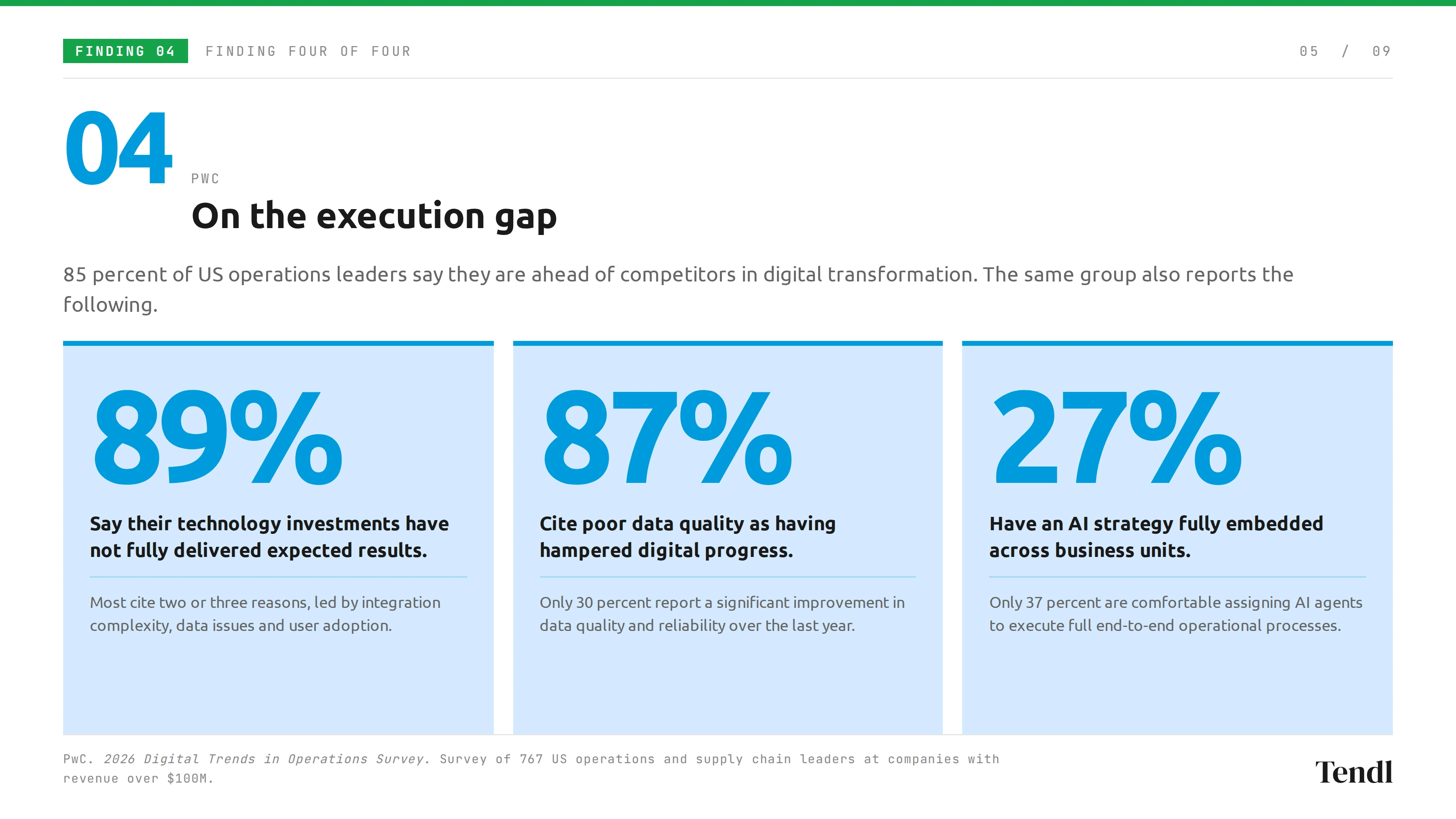
PwC, in its 2026 Digital Trends in Operations Survey of 767 US operations and supply chain leaders, finds that 89 percent of respondents say their technology investments have not fully delivered expected results, 87 percent cite poor data quality as having hampered progress, and only 27 percent have an AI strategy fully embedded across business units.
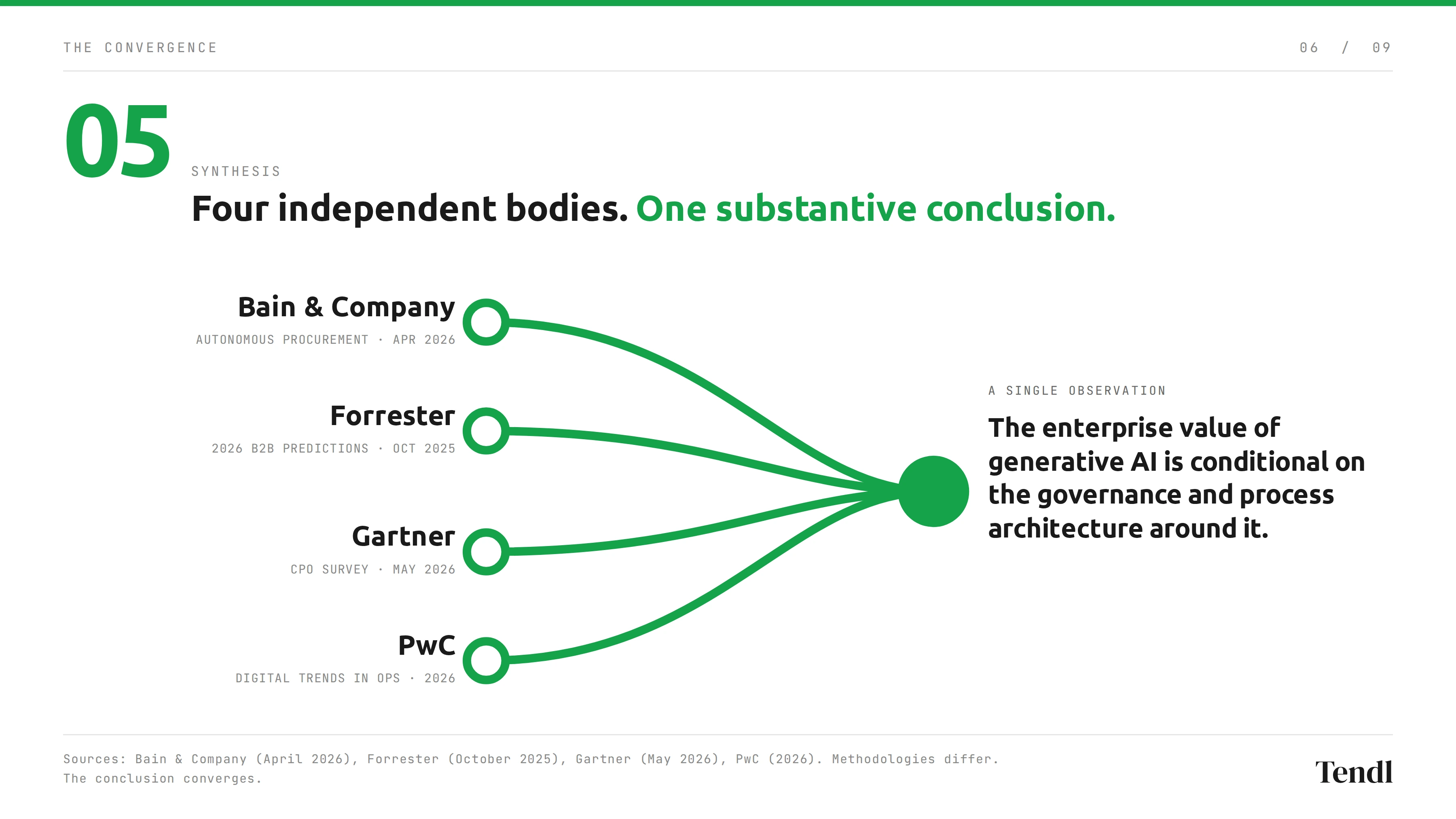
These four findings address different functions and use different methodologies. They converge on a common observation: the enterprise value of generative AI is conditional on the quality of the governance, data architecture and process design within which it operates.
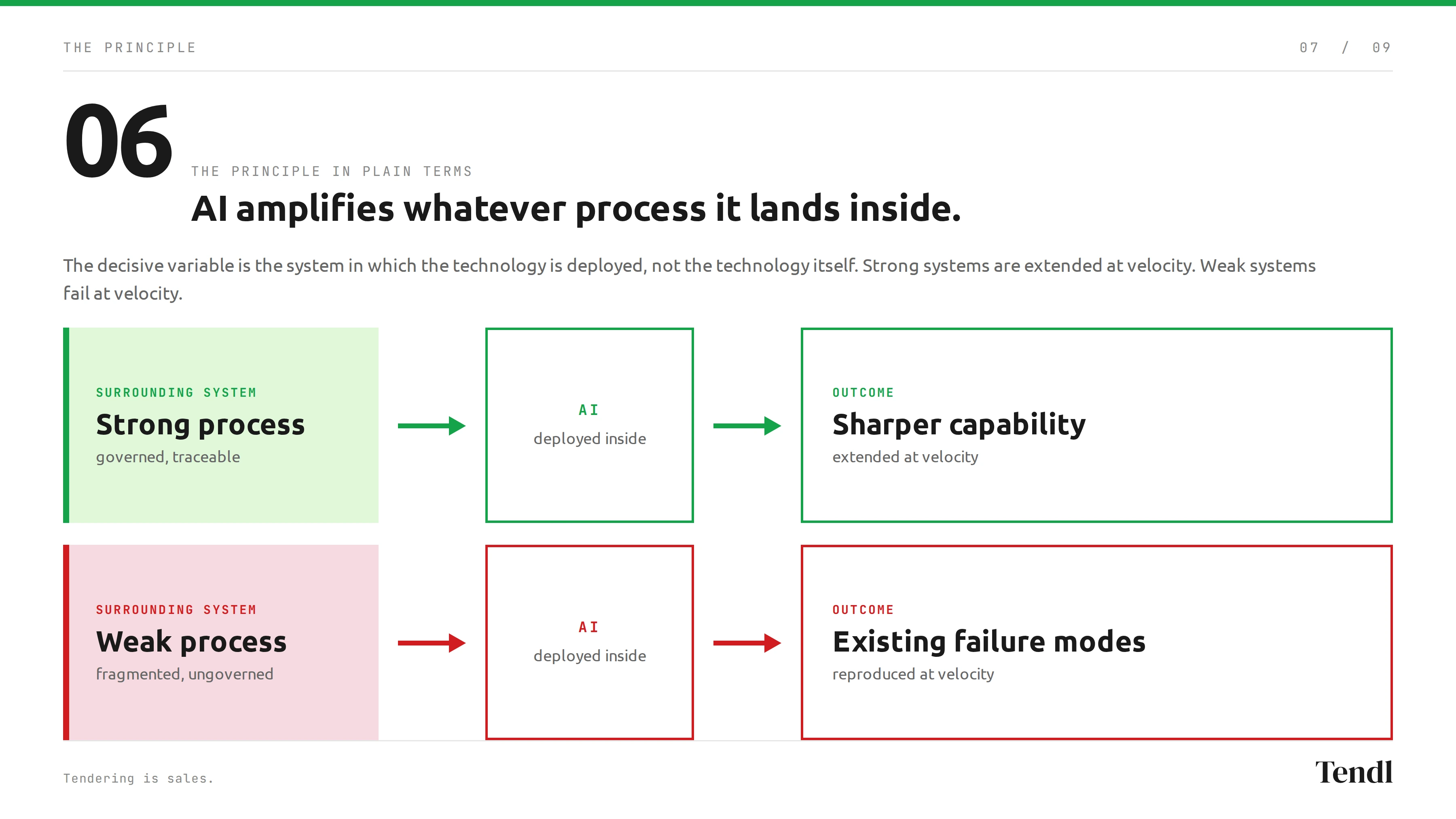
Where that surrounding structure is sound, AI extends existing capability. Where it is absent or weak, AI accelerates existing failure modes. The decisive variable is the system in which the technology is deployed, not the technology itself.
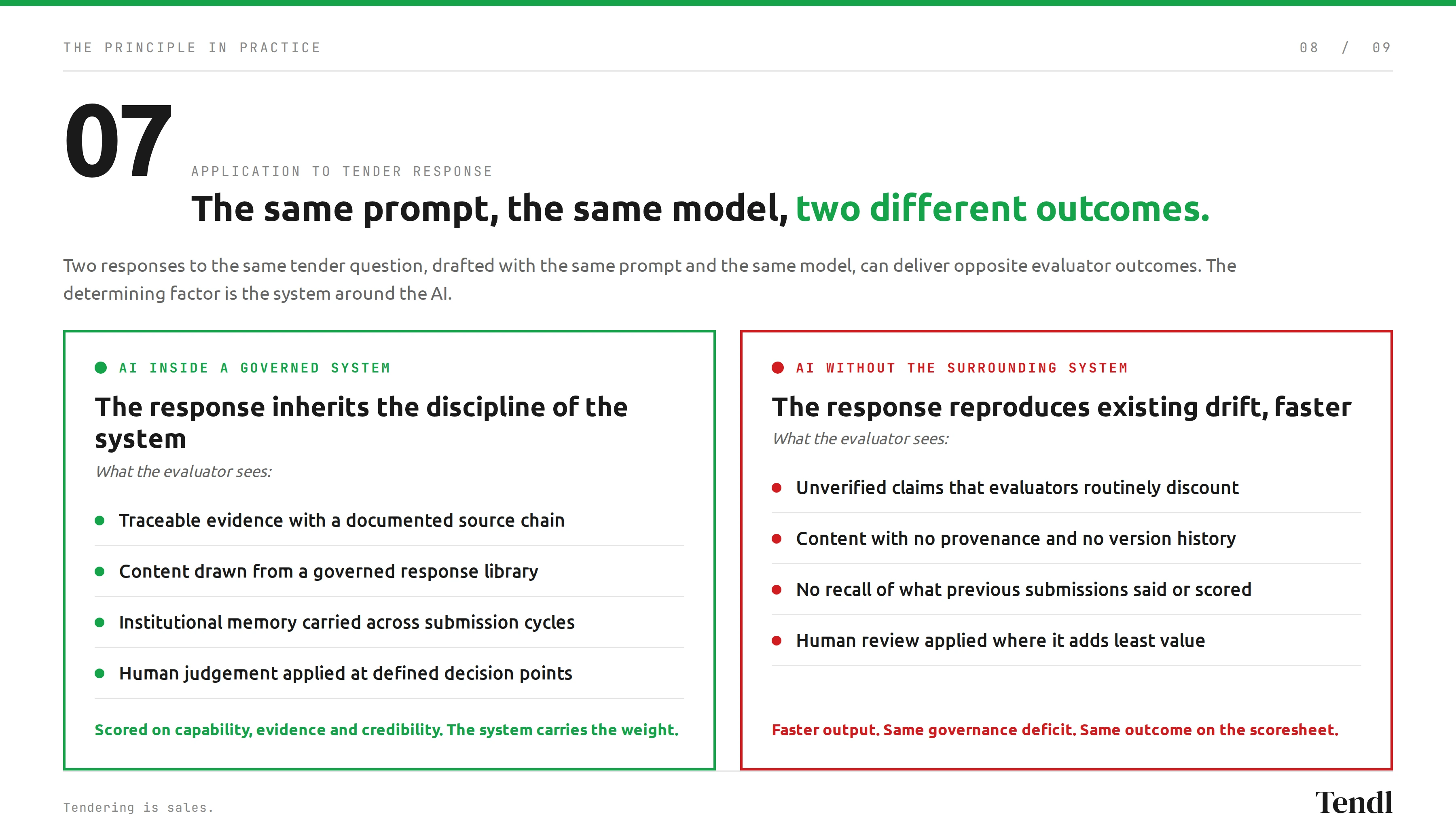
The implication for tender response is direct. Tendering is a commercially regulated activity in which evaluators score on evidence, traceability and demonstrable governance. A response generated by AI within a system that controls content provenance, maintains an institutional record of prior submissions, and preserves a clear chain of human judgement inherits the evidentiary discipline of that system. A response generated by AI in the absence of such a system reproduces, at greater speed and lower marginal cost, the same governance deficiencies the four research bodies describe.
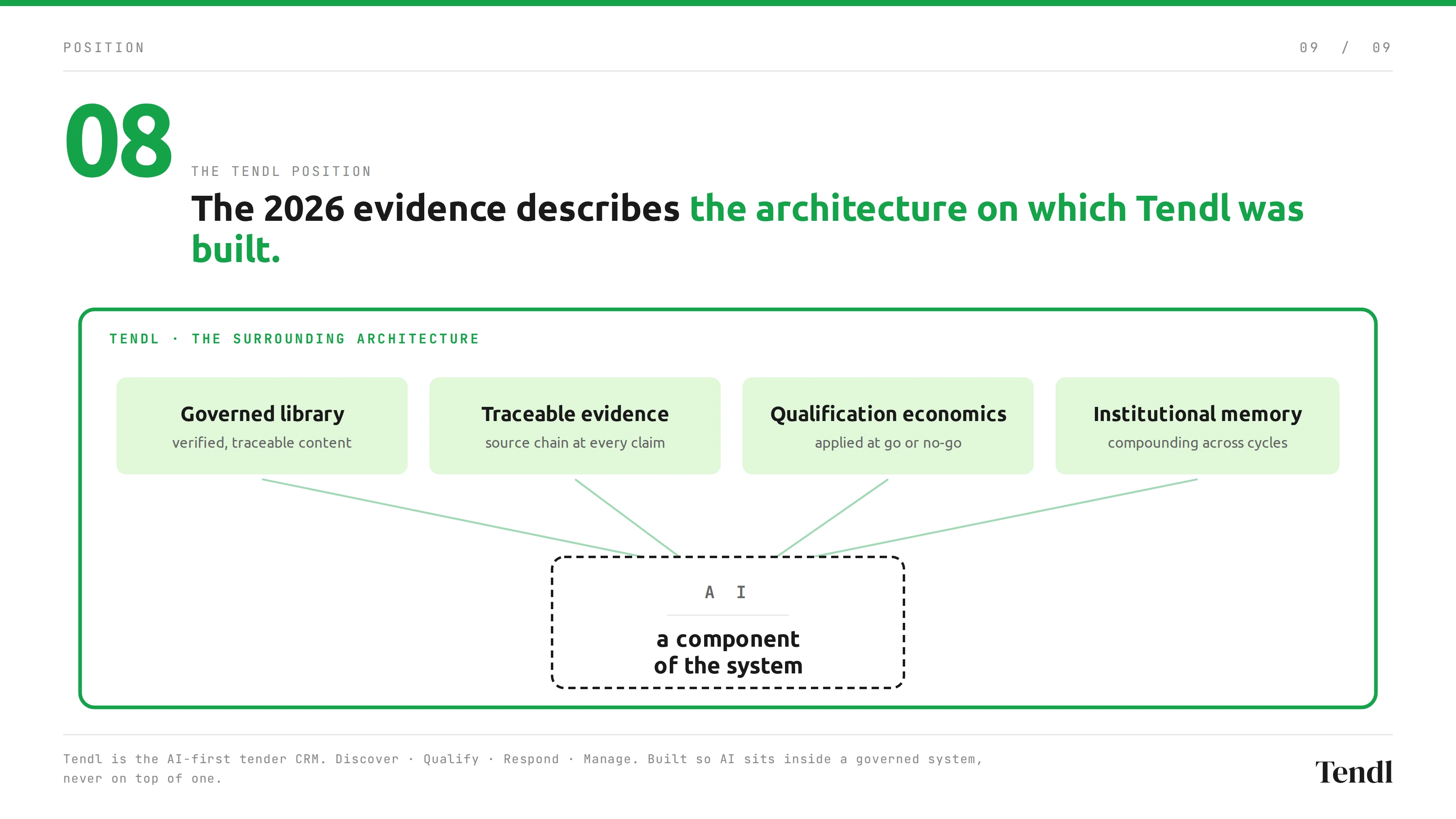
This is the operating thesis on which Tendl is built. The platform exists to provide the surrounding architecture that the 2026 evidence identifies as the determinant of AI value. A governed response library. Traceable evidence at every claim. Qualification economics applied at the point of go or no-go. A record of institutional memory that accumulates over each cycle. The position taken by Bain, Forrester, Gartner and PwC over the past several months is the position from which Tendl began, and the evidence is now catching up.
Research Sources
-
Bain & Company. The Rise of Autonomous, Intelligent Procurement. Brief by Brian Paul Murphy, Kalit Jain, and Sameer Bajaj. April 2026.
-
Forrester Research. 2026 B2B Marketing, Sales, and Product Predictions: B2B Companies Will Lose More Than $10 Billion Because Of Ungoverned Use Of Generative AI. Press release, 28 October 2025.
-
Gartner. Gartner Survey Shows Just 36% of Chief Procurement Officers Are Very Confident in Ability to Redesign Function for AI. CPO Survey, fieldwork January to February 2026, n=101. Released 19 May 2026 at Gartner Supply Chain Symposium/Xpo, Barcelona.
-
PwC. 2026 Digital Trends in Operations Survey. Survey of 767 US operations and supply chain leaders at companies with revenue over $100M.
Published by Tendl, the AI-first tender RMS. Discover · Qualify · Respond · Manage. Win the work you should be winning.