Most bid teams have already written their next winning bid. They just can’t find it.
Tender losses get blamed on price, on writing quality, on resourcing. The real cause can sometimes be right under your nose. The response that would have won was already produced inside the business. It just was not retrievable when it mattered.
The case study sat in a project folder no one had bothered to tag. The capability statement lived in an outbox no one knew to search. The differentiator that scored well last time left the building with the person who wrote it.
Most organisations call this asset a response library. In practice, what most teams have is a folder of past submissions: undated, untagged, ungoverned, and quietly out of sync with what the business currently delivers.
What teams call a response library is usually not one
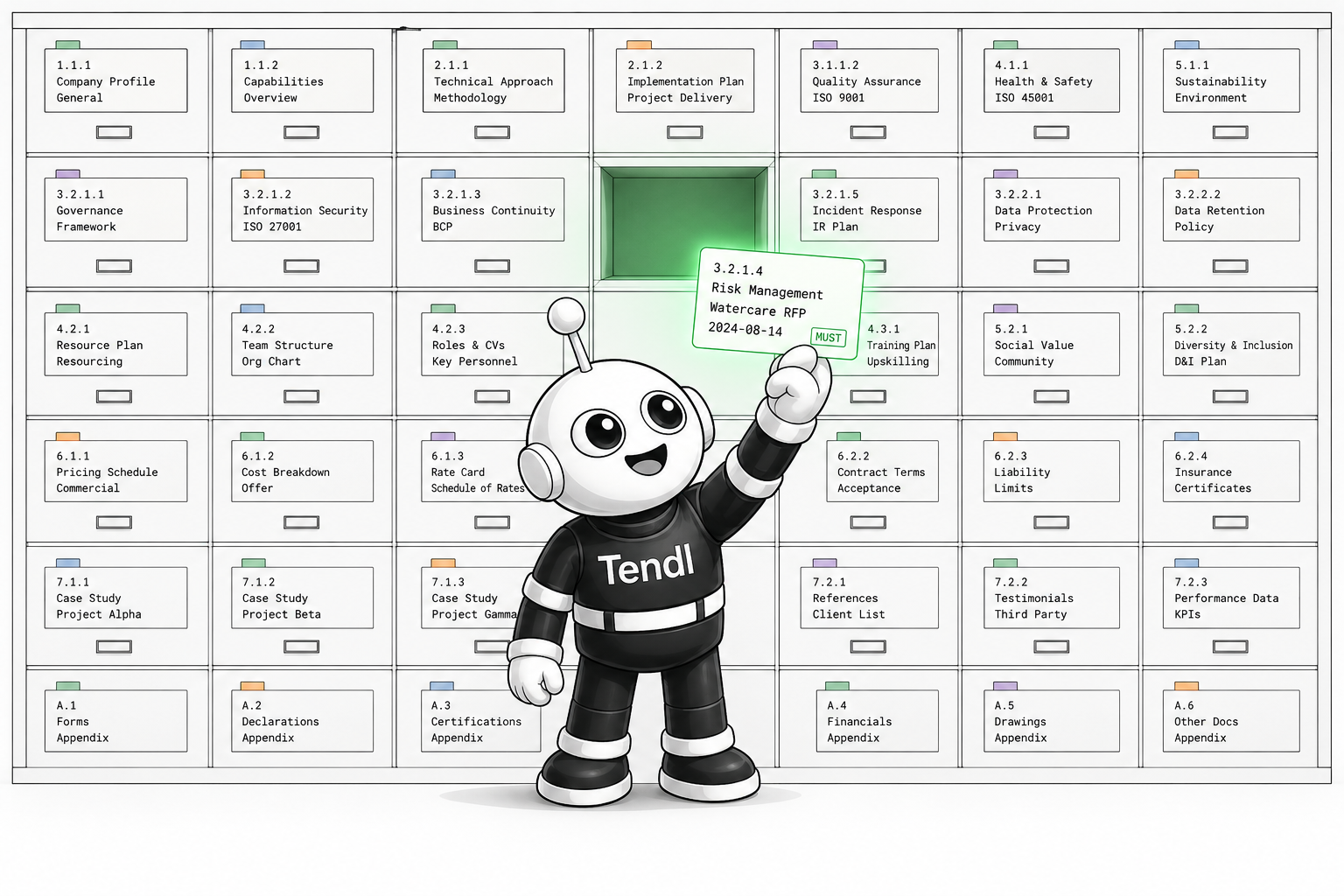
A library has a catalogue. Items are findable by criterion, by recency, by relevance. Content is accessioned, reviewed periodically, and retired when it stops reflecting the business.
The APMP Winning Business Ecosystem makes this explicit. It defines the Bid Coordinator role as the guardian of institutional knowledge, responsible after every submission for managing the reusable content library, tracking recurring compliance gaps, and archiving final documents and reviewer feedback (APMP, Winning Business Ecosystem). Library work, in other words, is a recognised stage of the bid lifecycle.
A folder is none of those things. It captures what was produced, without telling you what was won, what was responsive, or what is still defensible eighteen months later. Contracts expire and the case study quietly stops being usable. The team that delivered the project moves on, and the operational detail goes with them. Compliance statements age out of accreditation cycles. Pricing assumptions stop matching current cost bases.
No one notices, because no one is governing the asset. Until the next tender lands, and the question becomes whether the team can find proof of relevant experience inside a forty-eight hour drafting window. Most cannot. So they write something close from scratch.
Why retrievable proof is the only thing that scores
In Compliance is the Floor, we set out that the proposals with the highest win probability sit above the compliance gate, where evaluators score responsiveness and differentiation. Both layers depend on proof in a form the criterion can verify.
Proof of this kind has to exist in a governed form. It has to be indexed against the evaluation criteria a tender is most likely to bring. It has to be reviewed often enough that the team can trust it without re-checking. It has to be retrievable in seconds.
Most bid teams have the proof. Almost none have the infrastructure that turns it into an asset they can reach for.
The cognitive load of running retrieval by hand
Without that infrastructure, every tender begins with a hunt. Someone asks the team channel whether anyone remembers writing a similar response. Someone else opens four old submissions in different tabs, looking for a paragraph they half-remember. The bid manager messages the delivery lead to check whether the headline number from the 2023 project is still defensible in 2026.
By the time the draft is being written, half the cognitive effort has gone into finding evidence, validating it, and reshaping it for the criterion. The strategic work, deciding which proof makes the strongest case, gets squeezed into whatever time is left.
The bid that lands on the evaluator’s desk is compiled rather than designed. The team that produced it is exhausted before the strategic shaping has even started.
This pattern repeats on every pursuit, because the infrastructure that would prevent it does not exist in the business. Each bid pays the full retrieval cost from scratch.
How Tendl turns the library into infrastructure
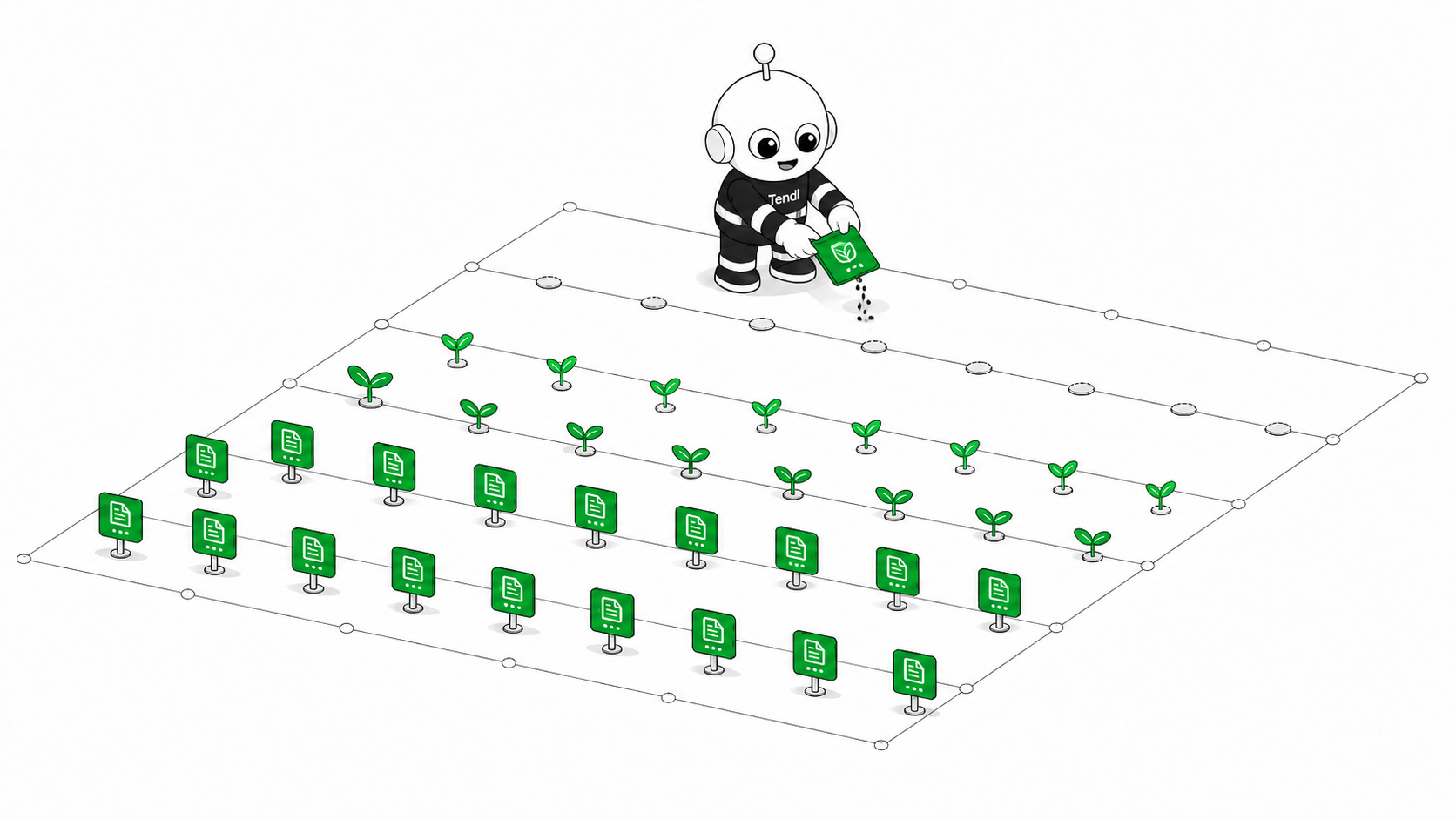
This is what Tendl absorbs. The response library becomes part of the system. Content is tagged against evaluation criteria, governed for currency, and surfaced against the questions the next tender brings. Evidence sits in a structure that the criterion can reach into.
When a new tender lands, the proof that scored last time is already retrieved. The differentiators that worked are surfaced. The case studies still in date are filtered from the ones that have aged out. The team opens a tender to find the retrieval work done before anyone got to it.
What gets handed back is the judgement layer. Which evidence makes the strongest case for this evaluator. Which differentiators land hardest for this buyer. Which case study sits closest to the question beneath the question.
That is the layer where wins are decided.
Institutional memory is a compounding asset
APMP’s framing puts the bid coordinator at the centre of institutional knowledge. The reality in most organisations is that the role exists, but the infrastructure underneath it does not. Knowledge is guarded inside the heads of people who happen to still be in the building, inside folders no one has the time to govern, inside submissions that are filed and never indexed again.
Capable organisations are losing work they already had the proof to win. The response was inside the business. It just was not where the team could reach it when the deadline was four days away.
The infrastructure that solves this turns a sequence of bids into a system. Every won response strengthens the library. Every differentiator that scored well becomes available to the next pursuit. Every piece of evidence that ages out gets retired before it becomes a liability.
Institutional memory stops being a function of who is still in the building. It becomes the platform for winning.