Evaluators are not looking for the best bid. They are looking for the safest one.
Most suppliers write tenders to impress. Evaluators score them to justify a decision, not make one.
That mismatch explains more lost bids than poor writing, weak pricing, or slow turnaround combined. The supplier thinks the job is persuasion, while the evaluator thinks the job is risk reduction. Until your bid team understands what evaluators are actually optimising for, you will keep losing to suppliers who are less capable but more credible on paper.
What Evaluators Are Actually Doing
Procurement evaluation is a structured exercise in risk management, and once you see it through that lens, a lot of confusing losses start to make sense. Evaluators are not choosing the supplier they like most. They are choosing the supplier they can most easily justify if something goes wrong.
This is rational behaviour. In public and regulated procurement, every evaluation decision must be defensible. If a contract fails, the question is not “why did this supplier underperform?” It is “why did you select them?” Every score on every criterion exists to create a paper trail that protects the buyer.
Research from World Commerce and Contracting (formerly IACCM), based on over twenty years of longitudinal data, consistently finds that more than 80% of contract negotiation time is spent on risk allocation terms such as limitation of liability and indemnification, rather than on value creation or innovation (WorldCC Most Negotiated Terms 2024). That pattern does not begin at the contract stage. It runs through the entire procurement lifecycle, starting with how evaluators read and score your tender response.
Why Good Suppliers Still Lose
Capable organisations lose bids regularly because they confuse capability with credibility, and the difference between those two things is where most tender outcomes are actually determined.
Capability is what you can do. Credibility is what you can prove, in the format the evaluator needs, against the criteria they have published, with evidence they can verify. A supplier might have fifteen years of relevant experience, but if the response buries that proof in dense paragraphs or fails to map directly to the evaluation criteria, the evaluator cannot score it well. They may want to. But the scoring framework constrains them.
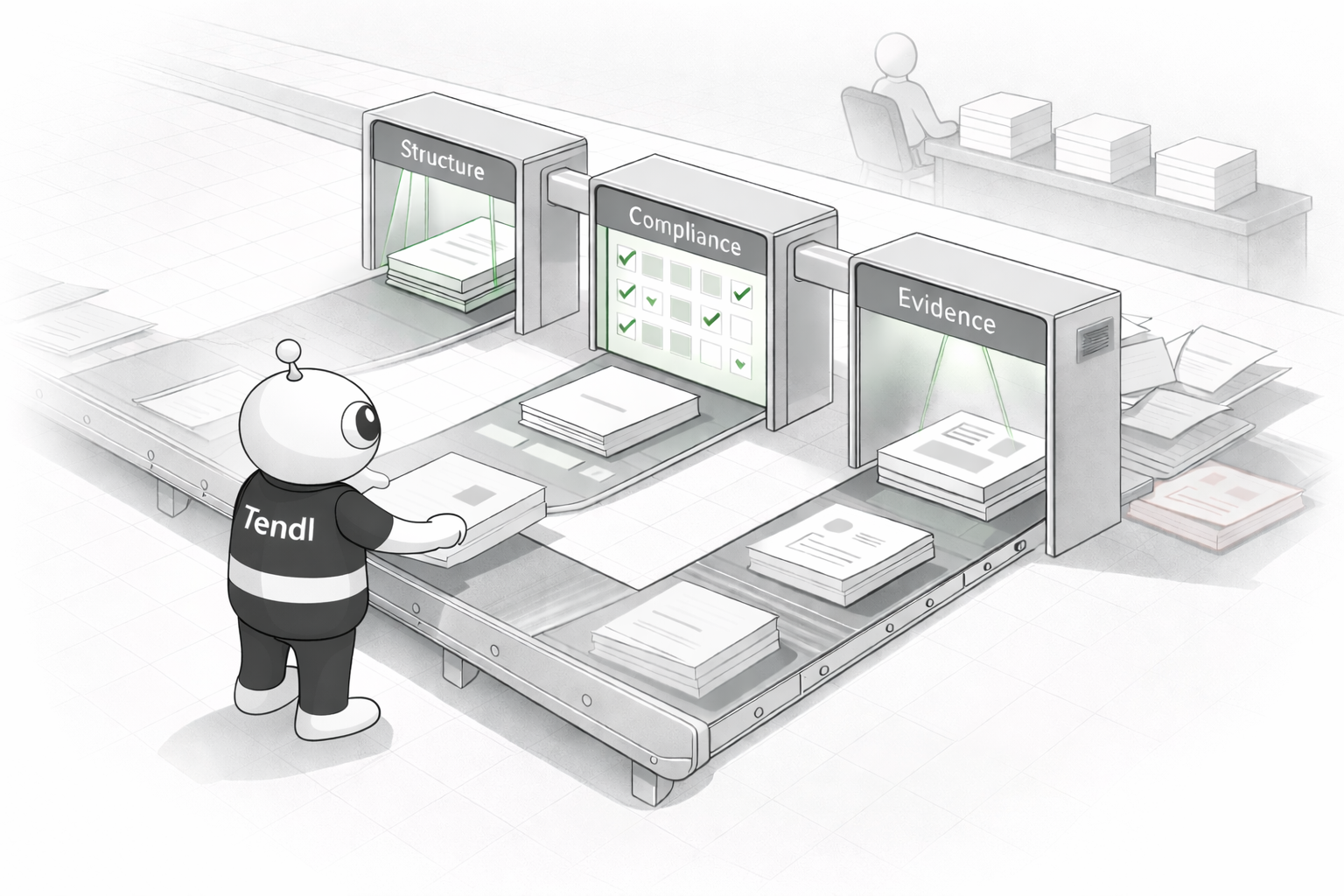
Evaluators work inside a system with criteria, weightings, and moderation panels. They cannot give you marks for things you imply but do not state. They score what is written, structured, and evidenced in front of them, and nothing else.
The Three Things Evaluators Actually Reward
Stripped of jargon, evaluators consistently reward three qualities in a tender response, and all three are design decisions rather than writing decisions.
- Traceability.
Every claim maps to a requirement, and every requirement has a response the evaluator can follow from what was asked to what was answered without guessing. - Evidence density.
Assertions are supported by proof: case studies with measurable outcomes, named projects, specific metrics, and process documentation. The response does not say “we have extensive experience.” It says where, when, for whom, and what the result was. - Structural clarity.
The response is easy to evaluate because headings match the tender structure, compliance is explicit, and the evaluator does not have to reinterpret what the supplier meant.
The Credibility Gap
Most bid teams spend the majority of their time on drafting, refining language, and polishing the narrative. This is understandable because writing is the most visible part of the process and the part that feels most like progress.
But drafting quality has diminishing returns once the response is coherent and professional. The gap between a well-written response and a winning response is almost never about the prose. It is about the evidence behind it.
A response that says “we delivered a similar project for a state government agency, reducing processing time by 35% across 12 months” is worth more than three paragraphs of articulate capability description. The evaluator can score the first statement against a weighting. The second reads well but gives them very little to actually mark.
This is where institutional memory becomes a serious competitive advantage. Organisations that systematically capture, tag, and govern their evidence can retrieve and deploy proof rapidly when a tender lands. Organisations that rely on individual memory and scattered folders lose time, miss evidence, and submit weaker responses as a result.
What This Means For How You Bid
If evaluators optimise for risk reduction, your bid strategy should optimise for credibility, and that work starts well before anyone opens a blank document.
It starts with qualification. A bid you cannot credibly evidence is a bid where you are asking evaluators to take your word for it. This is why planning is the highest ROI activity in tendering: the decisions you make before writing determine the ceiling on what writing can achieve.
It continues into response planning. Before drafting, the question for each evaluation criterion should be: what is the strongest piece of evidence we can provide? If the answer is “we will write something compelling,” you have a credibility problem, not a writing problem.
What Separates Organisations That Win Consistently
The interesting thing about evaluator behaviour is that it rewards the same organisations repeatedly, and not because those organisations are inherently more capable. It is because they have built systems that produce credible responses by default.
Organisations with high win rates tend to share a few structural traits. They qualify hard, which means they only enter competitions where they can field real evidence against the evaluation criteria. They maintain governed libraries of case studies, delivery data, and reusable proof, so evidence retrieval is a process rather than a scramble. And they treat tender activity as a pipeline with probability weightings and capacity constraints, not a queue of documents that arrive and get worked on in whatever order they land.
These are operational disciplines. Organisations aren’t winning by writing better sentences. They are fielding better evidence, faster, because their institutional knowledge is structured and accessible rather than trapped in inboxes and personal folders.
Evaluators do not give marks for eloquence, they give marks for proof they can defend. The sooner a bid team builds its operation around that reality, the sooner its win rate catches up with its capability.