The most expensive bid is the one you should have killed.
Every tender response spends real money and real evidence. The decision to enter is the most expensive single decision in the cycle, and most teams do not treat it that way.
Bid teams audit their drafting, their compliance, and their submission. Few audit the entry. The point of failure sits further upstream, in the room where someone said yes to writing the bid in the first place.
The real cost of writing a bid
What a single bid costs is rarely calculated. Fully loaded, it usually clears five figures once SME time, rework, internal coordination, and opportunity cost are counted. Laurie covered the underlying economics in What does it actually cost you to produce a bid?, and the answer surprised the commercial teams who ran the numbers themselves.
Once a bid carries a real dollar figure, the conversation changes. Every yes is a spend decision. The team is choosing where to put the bid budget for the quarter, whether they realise it or not, and that budget gets allocated by reflex if nobody is allocating it deliberately.
The work is significant enough to deserve that scrutiny. Loopio CEO Zak Hemraj has noted that “RFPs consistently generate more than a third of revenue for organisations”. A function of that size deserves the same commercial discipline as any other revenue channel.
The economics of the default yes
Most organisations submit on almost everything they qualify for. Some would call this ambition. However, commercially, it is a spending decision made without one being taken.
The economics do not hold up.
If a bid costs ten thousand dollars to produce and the team submits sixty per year, that is six hundred thousand dollars of effort going out the door. Without disciplined qualification, the cost per win climbs with every unwinnable submission the team enters, and the team’s busiest periods become the periods where margin disappears fastest.
The teams sitting on the worst economics tend to be the busiest. They are over-committed, writing into rooms where the decision has already been made and they are present as column fodder.
What qualification actually does
Qualification is the discipline that decides where the bid budget goes. It is the highest-leverage commercial decision in the tendering cycle, and the one most consistently treated as a meeting rather than a system.
The mature response teams have started treating it as a system, and it’s paying off. Loopio’s 2025 benchmark with APMP found that 83 per cent of teams now operate a formal go/no-go process, up from 77 per cent the year prior, and average annual submission volume fell from 175 to 153 over the same period. The teams investing in qualification rigour are bidding less, and the better-performing ones are winning more of what they enter.
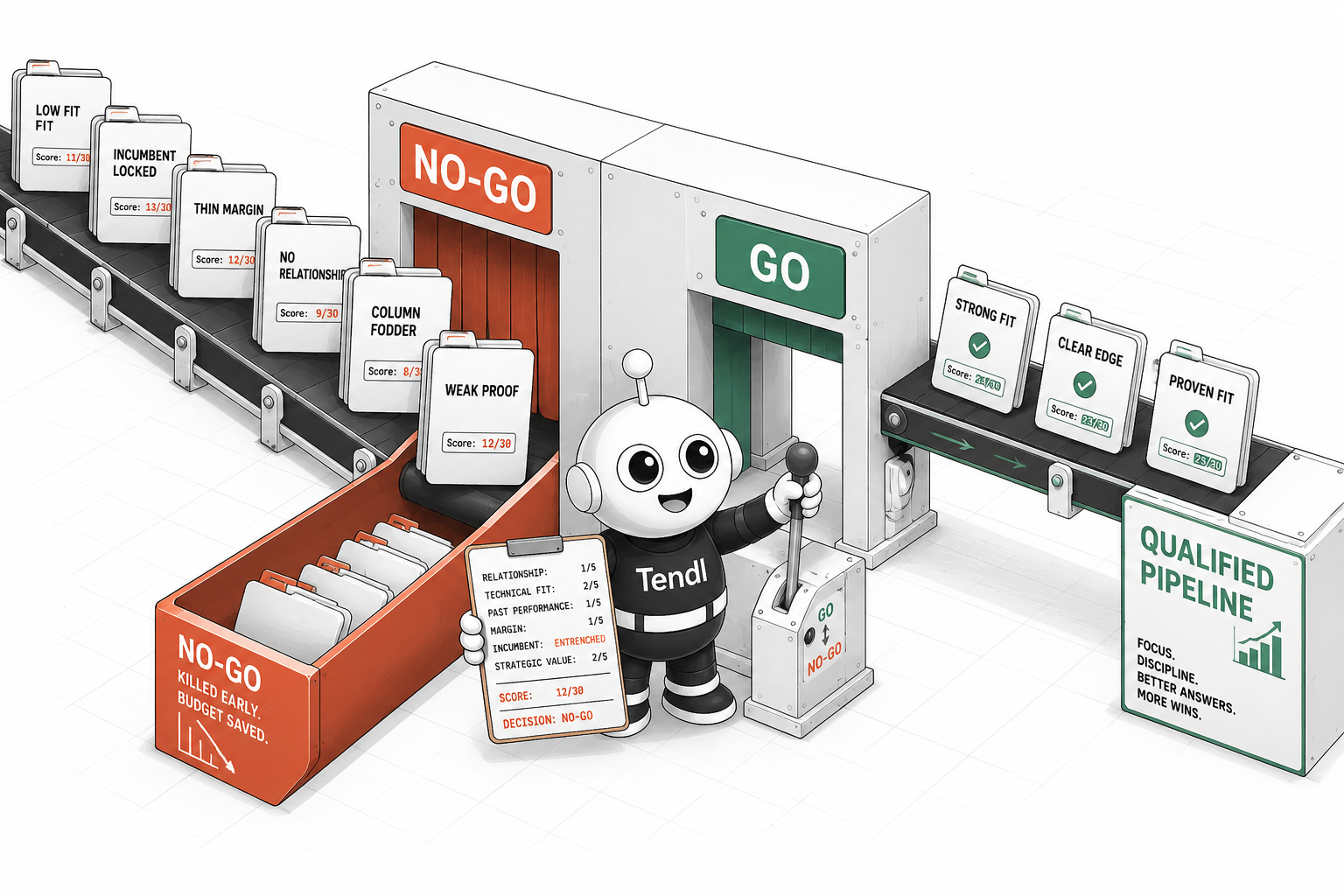
Done properly, qualification scores each opportunity against criteria the team has agreed in advance: buyer relationship, technical fit, relevant past performance, price competitiveness, incumbent position, and strategic value to the business. The score sets a position on the pipeline that everyone can see, and a kill criteria everyone has signed off on in calmer moments than the day the tender drops.
The work of qualification is the work of saying no to enough of the wrong bids that the right ones get the team’s full attention. That is what protects margin, raises win rate, and makes the forecast worth quoting.
Qualifying out is the most profitable thing a bid team does
A killed bid does not lose money. A killed bid frees the budget for a bid that pays back.
The arithmetic compounds quickly. Cut fifteen unwinnable submissions from the year and the team could recover one hundred and fifty thousand dollars of capacity (many teams much more). Redirect that capacity into qualification rigour and pursuit planning on the bids that remain, and win rate rises across the smaller portfolio. Cost per win falls, forecast confidence rises, and the team that bids less wins more.
The discipline is uncomfortable in the moment. Saying no to a real opportunity in front of a real client is a harder conversation than saying yes. The teams that hold the line on qualification accept that discomfort as the price of running tendering as a commercial system.
What qualification looks like inside infrastructure
In most organisations, qualification is a meeting. Inside a system, it becomes infrastructure.
Tendl runs structured Go/No-Go scoring against each opportunity, weighted by the criteria that matter to the business. Scores feed directly into the pipeline. Bids below the threshold get killed early and visibly, with the reasoning recorded for the next time a similar opportunity appears. Bids above the threshold inherit a clear set of reasons the team is entering, a clear set of risks, and a clear set of win themes to carry into the response.
The pipeline view that results is closer to reality. It reflects the team’s actual probability of winning the work in front of them, rather than the volume of opportunities they happen to be aware of. That distinction is what separates a tender pipeline from a tender to-do list, and it is what allows revenue leaders to put a number on tender income with any confidence.
The bottom line
Win rate is rarely the real constraint. Entry rate is.
Teams that win more enter fewer rooms, and the rooms they enter are the ones they should be in. The decision happens at qualification, and the team that runs qualification as a discipline runs tendering as a commercial system.
Test your own qualification rigour with the free Go/No-Go Scorecard, below. Five minutes, no commitment, a clear read on whether your team is entering deliberately or by default.